Also known as Kristo Shuli, he was born in the village of Marjan. When he was still a child, his family moved to the nearby city of Korça, where he spent his childhood. Somewhere around the end of the 19th century, like many other area residents, he emigrated to Greece for economic reasons. Allegedly he brought out the art of photography in Athens, under circumstances we don't know and probably will never do. <br><br>
In Athens, in this period, there was a large community of Albanians, mainly from the south-east of the country, who also regularly published their newspaper "Zëri i Shqiperise" (H ΦΩNH THΣ AΛBANIAΣ), which was one of the first press organs of the Albanian National Reawakening. Sulidhi was its main collaborator for many years and often published writings with patriotic fervor aimed at national awakening. In these years, he travels to the Albanian colonies of Istanbul, Egypt, and Bucharest - trips which must have stirred the boy's feelings about the national issue even more. The idea of independence from the Ottoman Empire had awakened Albanian nationalism, and the Albanian diaspora colonies, through their publications and newspapers, had become the main centers of spreading and promoting the idea of an independent Albanian state.<br><br>
The reasons for Sulidhi's return to troubled Albania in the late 19th century remain unknown. Around the 1890s, maybe a little earlier, he finally settled in Korça, where he opened a photography studio in the backyard of his house, thus becoming one of the first (if not the first) photography studios in the city.<br><br>
The earliest evidence of his photographic activity in Korça dates around 1893. In some early prints, we also find the first stamp of the studio written in Greek: "Photograph of Kristo Sulidhi from Korça," which he did not use anymore in the following years. The most photographed characters at this time were from the wealthy classes of the city, who, amazed by the magic of photography, wanted to have a portrait of themselves as a memory, alone or with family members.<br><br>
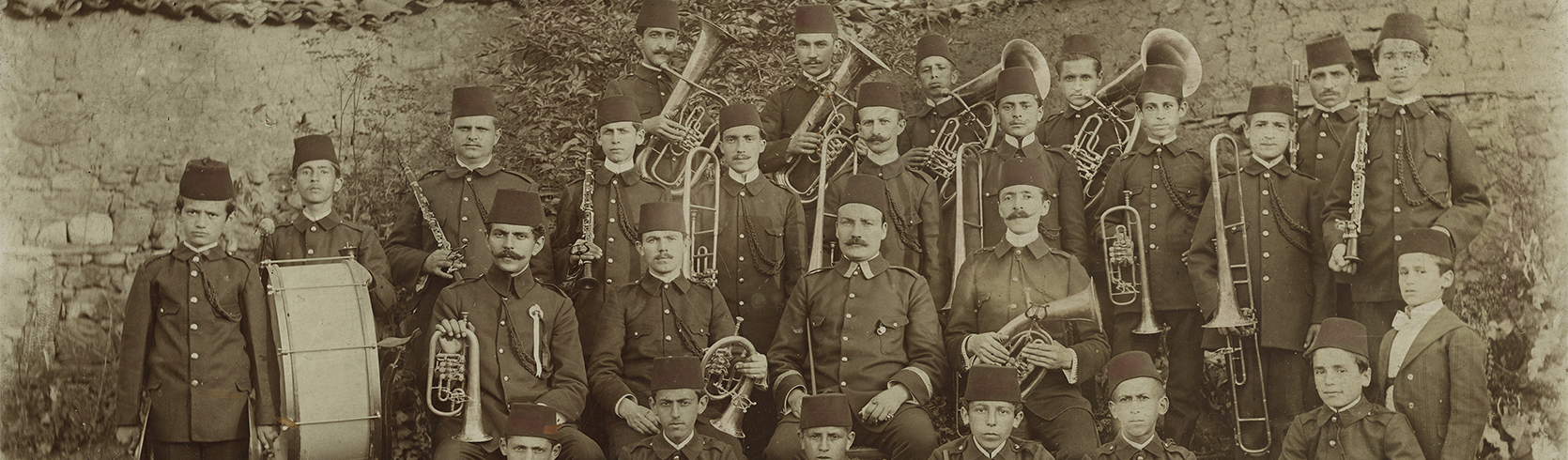
A few years later, the photographed subjects diversified, with portraits and genre scenes, but also with shots taken outside the studio. Among the unusual photos of this period, which prove outstanding compositional skills, are shots of Greek school students, members of an unidentified fraternity, the band of the city, and some landscapes from the villages around Korça.<br><br>
Work in the studio goes well for Kristo Sullidhi, who quickly gains a reputation in the city. At this time, he also produces personalized cardboards printed in French with the imprinted logo "Ch.P. Soulides Coritza."<br><br>
The emblematic shots of the 'Albanian Teacher of Korça' and of the 'School of Girls' belong to these years (1899).<br><br>
The close relationship with the Evangelical Mission operating in the city, whose activity mainly focused on opening Albanian schools and publishing Albanian books, was seen with concern by the church of Fanari. His agitating activity for the national cause and his commitment to the Evangelical Mission aroused the resentment of the Ottoman authorities, but especially of the Patriarchate of Istanbul, which also brought his curse and ex-communication. (Korça newspaper, May 21, 1938)<br><br>
Branded with the nickname 'Kristo the Masson,' he is forced to leave Korça for some time. There is no record of his return to the city and the studio's reopening. He devoted the last period of his life to photography alone. His activity continued uninterrupted until the end of the 1920s. He died in Korça in 1938.<br><br>
After his death, the rich archive of Kristo Sulidi (about 20,000 glass negatives) was almost destroyed, as much due to the negligence of his family members as to the lack of interest from the cultural institutions of the time. Thousands of glass plates were damaged by mishandling and then trashed. Very little is left of the half-century production of this pioneer of Albanian photography. Sporadically collected original prints are the only surviving evidence of his work.<br><br>
The shots of the members of the Freedom Band (1909), the group of Greek school students (1895), and the boy with the Ottoman fez on his head posing with the newly bought bicycle (1910) are among the most beautiful shots in the history of Albanian photography.<br><br>
These few remaining shreds of evidence, fragments of an incredible masterful output, make us understand the extent of this devastating loss for Albanian culture.<br><br>
Rubens Shima
@@@@@@@
The reasons for Sulidhi's return to troubled Albania in the late 19th century remain unknown. Around the 1890s, maybe a little earlier, he finally settled in Korça, where he opened a photography studio in the backyard of his house, thus becoming one of the first (if not the first) photography studios in the city. ##### ##### ##### The shots of the members of the Freedom Band (1909), the group of Greek school students (1895), and the boy with the Ottoman fez on his head posing with the newly bought bicycle (1910) are among the most beautiful shots in the history of Albanian photography.
@@@@@@@
Kristo Sulidhi | Portrait of Mrs. Viktori Bratko, Korçë | ca. 1900-1910 | print on paper
@@@@@@@
Kristo Sulidhi | Dhimitër Emanuil Mborja, Jaup Bej Dishnica posing with guns | ca. 1905-1910 | print on paper